Ambulance Door Handles Guide: Materials, Standards & OEM Solutions
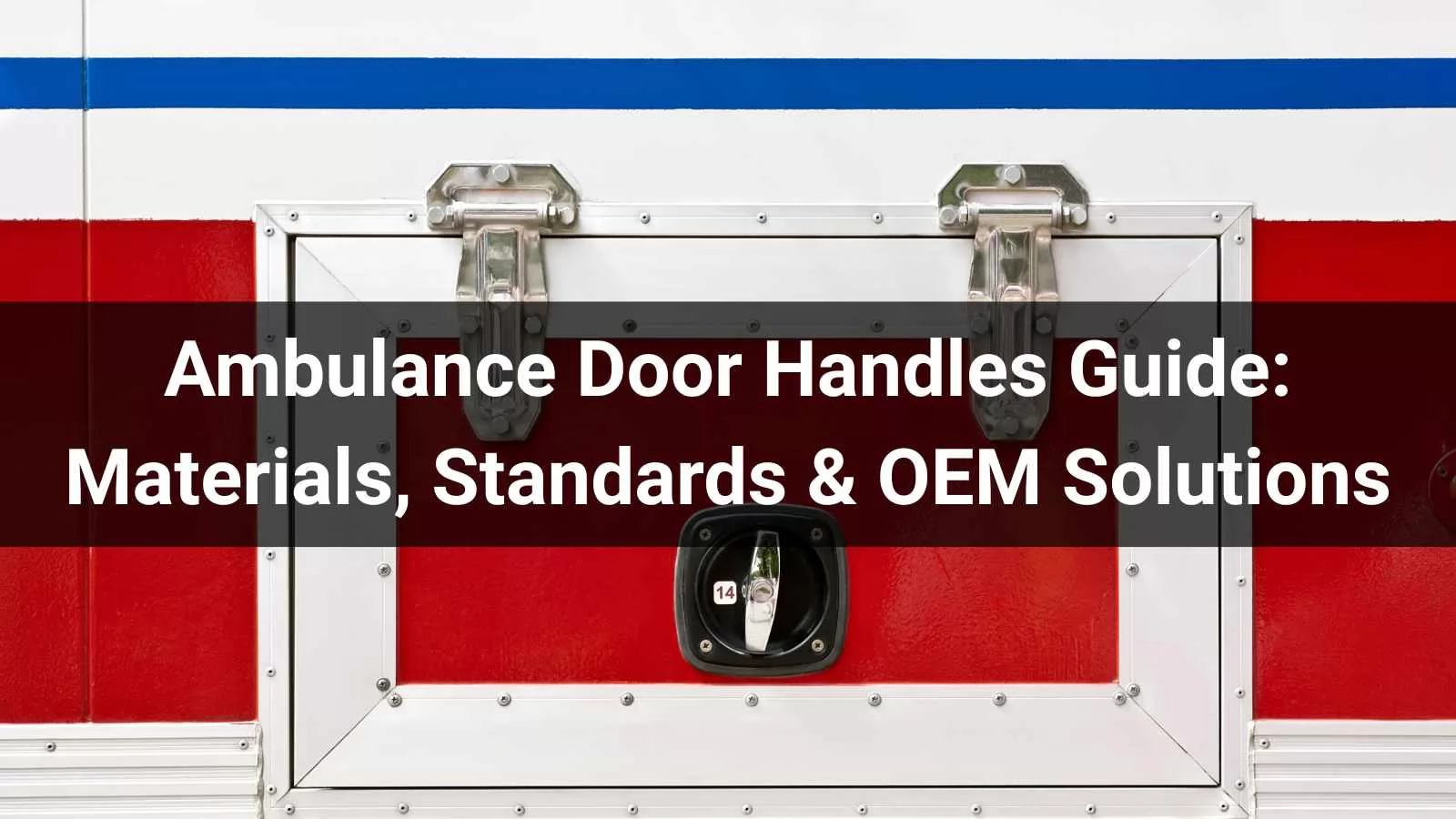
Ambulance door handles are far more than simple access hardware. Used repeatedly in demanding operating conditions, they must provide secure, convenient access while working reliably with the vehicle's door and locking system. For ambulance manufacturers, specialty-vehicle builders, fleet operators, and hardware distributors, choosing the right handle involves more than checking whether it fits a door panel. Material selection, mounting dimensions, locking configuration, surface treatment, operating environment, and OEM customization all affect the final operational outcome. This guide provides an in-depth look at ambulance door handle types, material trade-offs, compliance considerations, and practical criteria for selecting an OEM hardware supplier.
Table of Contents
1. What Is an Ambulance Door Handle?
2. Ambulance Door Handle vs. Door Latch
3. What Makes Ambulance Door Handles Different?
4. Common Types of Ambulance Door Handles
5. Which Material Is Best for an Ambulance Door Handle?
6. Surface Treatments for Ambulance Door Handles
7. Ambulance Door Handle Standards and Compliance
8. How to Choose an Ambulance Door Handle & Buyer Checklist
9. OEM Customization for Ambulance Door Handles
10. Common Ambulance Door Handle Problems
11. Why Choose East Sea Machinery for Ambulance Door Handles?
12. Conclusion
1. What Is an Ambulance Door Handle?
An ambulance door handle is the user-operated hardware used to open and access an ambulance door or equipment compartment. Depending on the vehicle design, it works together with a latch or locking mechanism that keeps the door securely closed during operation.
Ambulance door handles may be installed on:
- Main entry doors and passenger access points.
- Rear access doors for emergency patient entry.
- Side doors and modular cab access.
- Equipment compartments housing critical medical tools.
- Service and storage compartments across exterior vehicle walls.
Because these doors may be opened frequently during emergency response and routine servicing, the handle needs to provide consistent operation and maintain secure mounting throughout its service life.
2. Ambulance Door Handle vs. Door Latch
A handle and a latch perform different functions. The handle is the part operated by the user, while the latch retains the door and releases it when the handle is actuated. For OEM projects, they should be considered as part of the same door assembly. Handle dimensions, mounting position, connection method, and latch configuration must be fully compatible. When specifying your overall vehicle hardware, integrating high-performance ambulance door latches ensures optimal alignment and smooth operational response.
3. What Makes Ambulance Door Handles Different?
Ambulance door hardware operates under conditions that can be more demanding than those of ordinary passenger vehicles:
Frequent Operation
Ambulance doors and compartments can be opened many times throughout a vehicle's working life. Frequent operation places greater demands on the handle, mounting points, and connected hardware. For OEM buyers, initial appearance or low purchase price should not be the only selection criteria; mechanical construction and long-term consistency are equally important.
Vibration and Impact
Ambulances regularly travel on roads under unpredictable conditions. Continuous vibration can place stress on mounting points, while repeated door closing can increase wear on the handle and connected components. A suitable handle should remain securely mounted and provide consistent operation during normal vehicle use.
Corrosion and Environmental Exposure
Emergency vehicles can be exposed to rain, humidity, road contaminants, cleaning agents, and repeated washing. The combination of base material and surface treatment therefore has an important effect on service life. A corrosion-resistant finish can be particularly important when vehicles operate in humid or coastal environments.
Secure but Accessible Operation
An ambulance door needs to remain securely closed while the vehicle is moving but should also be straightforward for authorized personnel to operate. The appropriate handle configuration depends on whether the hardware is being used for a primary access door, rear door, or equipment compartment.
4. Common Types of Ambulance Door Handles
Different ambulance platforms use different door structures and locking arrangements. The most suitable handle depends on available installation space, door construction, required security, and the connection to the latch:
1. I-Type Handle Locks
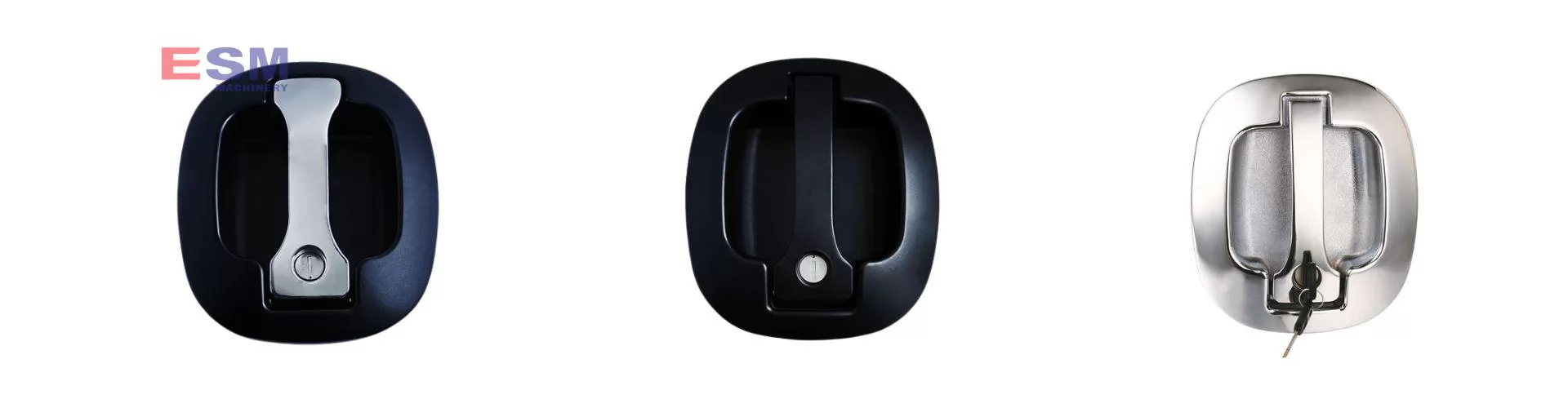
I-Type handle locks combine a handle with an integrated locking configuration. They are ideal for specialty-vehicle and equipment-door applications where both access and locking functions need to be incorporated into the same hardware. Ningbo East Sea Machinery's I-Type Handle Lock is designed specifically for emergency vehicles, engineered with high-strength zinc alloy and customizable surface treatments.
2. T-Handles
T-handles provide a straightforward gripping surface and are widely used in vehicle compartments and service doors. They offer robust external operation, provided that clearance and linkage connections are properly matched.
3. Flush Handles
Flush handles have a low-profile design that minimizes protrusion from the vehicle body. They are useful where exterior clearance is limited or where a streamlined vehicle profile is preferred for safety and aerodynamics.
4. Lever-Style Handles
Lever-style handles provide a familiar operating motion and are suitable for frequently accessed internal or external doors. OEM buyers should evaluate the complete hardware linkage to ensure full interior latch compatibility.
5. Which Material Is Best for an Ambulance Door Handle?
There is no universal "best" material for every ambulance door handle. The choice should reflect required strength, corrosion resistance, weight, surface finish, production method, and operating environment.
- Zinc Alloy: Provides a useful balance of mechanical performance, casting flexibility, surface-finish options, and production cost. Its ability to form complex shapes makes it suitable for vehicle hardware with integrated locking features.
- Stainless Steel: A strong option when corrosion resistance is a primary requirement, especially for vehicles exposed to high moisture, road salt, or continuous chemical washdowns.
- Aluminum Alloy: Considered when weight reduction is important. It offers lightweight performance along with good corrosion resistance and structural flexibility.
| Material | Main Advantage | Key Consideration |
|---|---|---|
| Zinc Alloy | Good balance of strength, flexibility, and cost | Requires suitable surface protection |
| Stainless Steel | Excellent corrosion resistance | Higher cost and weight |
| Aluminum Alloy | Lightweight construction | Application-specific strength requirements |
For OEM programs, material should be specified together with the handle design, finish, mounting configuration, and expected service environment.
6. Surface Treatments for Ambulance Door Handles
The surface treatment protects the underlying material and influences both appearance and resistance to environmental exposure:
Electroplating: Provides a protective and decorative metallic finish on metal components, recommended when a smooth metallic appearance and salt-spray defense are needed.
Powder Coating: Delivers a uniform protective finish, allowing custom color selections while providing outdoor resistance against moisture, abrasion, and cleaning chemicals.
Effect on Service Life: Material selection alone does not determine overall lifespan. Surface preparation, coating thickness, and operating conditions directly affect long-term durability. OEM buyers should evaluate base material and surface finish as a single unified specification.
7. Ambulance Door Handle Standards and Compliance
Door handles form part of the overall door hardware system, so regulatory compliance should not be evaluated by considering the handle in isolation.
FMVSS 206 & Door Retention Requirements
FMVSS 206 addresses door locks and door retention components for motor vehicles. Relevant requirements involve door latches, hinges, locks, and structural mountings. A manufacturer should not assume that a standalone handle is automatically compliant on its own; instead, vehicle manufacturers must verify that the complete door assembly satisfies all applicable retention standards.
Regional and Vehicle-Specific Criteria
Requirements vary depending on vehicle categories, target destination markets, and emergency response classifications. International OEM programs often include custom fleet specifications in addition to national regulations.
8. How to Choose an Ambulance Door Handle & Buyer Checklist
The best handle matches the actual door design and operational requirements. Buyers should evaluate the vehicle door configuration, confirm exact mounting dimensions (hole spacing, cutout depth, panel thickness), select materials based on environment, and determine keying/latching setups.
Ambulance Door Handle Buyer Checklist
- Door Type & Application: Main access, rear door, or side utility compartment.
- Panel Specifications: Material type and precise panel thickness.
- Mounting Dimensions: Cutout footprint, hole spacing, and connection mechanisms.
- Locking Setup: Keyed alike, non-keyed, single-latch, or double-latch system.
- Material & Finish: Zinc alloy, stainless steel, or aluminum with electroplated/powder-coated protection.
- Standards & Customization: FMVSS 206 verification and OEM CAD customization capability.
9. OEM Customization for Ambulance Door Handles
Standard catalog hardware does not always fit custom specialty vehicle platforms. OEM customization options include:
Custom Dimensions & Mounting: Modifying mounting hole footprints, cutout contours, and linkage rods based on customer technical drawings.
Locking Configurations: Integrating master keying, keyed-alike systems, or single/double rotary latch setups during production.
Tailored Finishes & OEM/ODM Support: Specifying exact plating or powder coat colors. Full OEM/ODM manufacturing encompasses tooling, die-casting, precision machining, rigorous QC, and specialized packaging.
10. Common Ambulance Door Handle Problems
Field operation issues are often tied to installation, wear, or environment:
- Loose Handle Movement: Often caused by mounting hardware wear or panel flex. Inspect mounting points before full replacement.
- Difficult Operation: Binding can result from latch misalignment, debris accumulation, or internal mechanical wear.
- Lock Misalignment: Indicates shifted alignment between the handle, key cylinder, latch, and door strike frame.
- Corrosion / Surface Damage: Signals that the existing hardware or surface finish is inadequate for the operating environment, warranting replacement with higher-grade hardware.
11. Why Choose East Sea Machinery for Ambulance Door Handles?
East Sea Machinery specializes in high-performance commercial and emergency vehicle hardware. The matrix below outlines ESM's core capabilities for custom OEM projects:
| Requirement | East Sea Solution |
|---|---|
| Product Model | I-Type Handle Lock Series |
| Material Standard | High-strength die-cast zinc alloy / stainless steel options |
| Surface Treatment | Advanced electroplating / UV-resistant powder coating |
| Locking Options | Keyed alike / non-keyed / master key configurations |
| Latch Configuration | Single-latch / double-latch mechanism integration |
| Panel Compatibility | Steel, aluminum, and composite sandwich panels |
| OEM Capability | Full 3D CAD design, custom mounting footprints, and custom tooling |
This complete configuration gives OEM buyers maximum flexibility when developing door hardware for different vehicle platforms. For complete specifications and model variants, explore our detailed I-Type Handle Lock product page.
12. Conclusion
Selecting the correct ambulance door handle requires balancing physical dimensions with material selection, surface protection, latch integration, and regulatory compliance. For vehicle builders and hardware distributors, partnering with a supplier capable of offering both robust standard hardware and tailored OEM customization greatly streamlines product development. Ningbo East Sea Machinery provides versatile I-Type handle locks and vehicle hardware solutions built for extreme reliability in field operations.
Ready to optimize your emergency vehicle hardware supply chain? Get in touch with our technical sales team today to review CAD files, request samples, or obtain custom volume quotes.
Need Help? We're Here For You!
Frequently Asked Questions (FAQ)
0
Comments
Leave a Comment
Your email address will not be published. Required fields are marked *
Name can't be empty
Email error!
Message can't be empty
😍
😜
😳
😌
😄
😘
😝
😒
😃
😚
😚
😛
😟
😧
😀
😉
😓
😱
😤
😣
😂
😥
😩
😠
😢
😭
😰
😨
😡
😆
😪
😅
😐
😇
😋
😴
👿
😕
😏
😷
😵
😟
😮
😯
😑
👧
👴
😧
😬
😾
👶
👱
👵
👸
🙀
👺
👦
👩
👨
😽
😿
🙈
💩
💥
💤
😼
😹
🙉
🔥
✨
💦
👎
✌
👆
👈
💪
💹
👍
👊
💴
💶
💷
💸
👉
💵
🙏
🌎
🏧
👏
💳
👇
💑
🙆
🙅
💁
👫
👭
🙎
🙇
👑
👔
Submit Comment
Most Popular
-
 Dec 25, 2025Truck Tool Box Lock Won't Open? Complete Repair Guide 2026
 -
 Jul 29, 2026Top 10 Most Popular Pickup Truck Models in the Americas in 2026
 -
 May 29, 2026What Are the Different Types of Toolbox Locks?(Comprehensive Guide)
 -
 Oct 17, 2025Top 10 Truck Tool Box Lock Manufacturers in the World


Laster Blogs
-
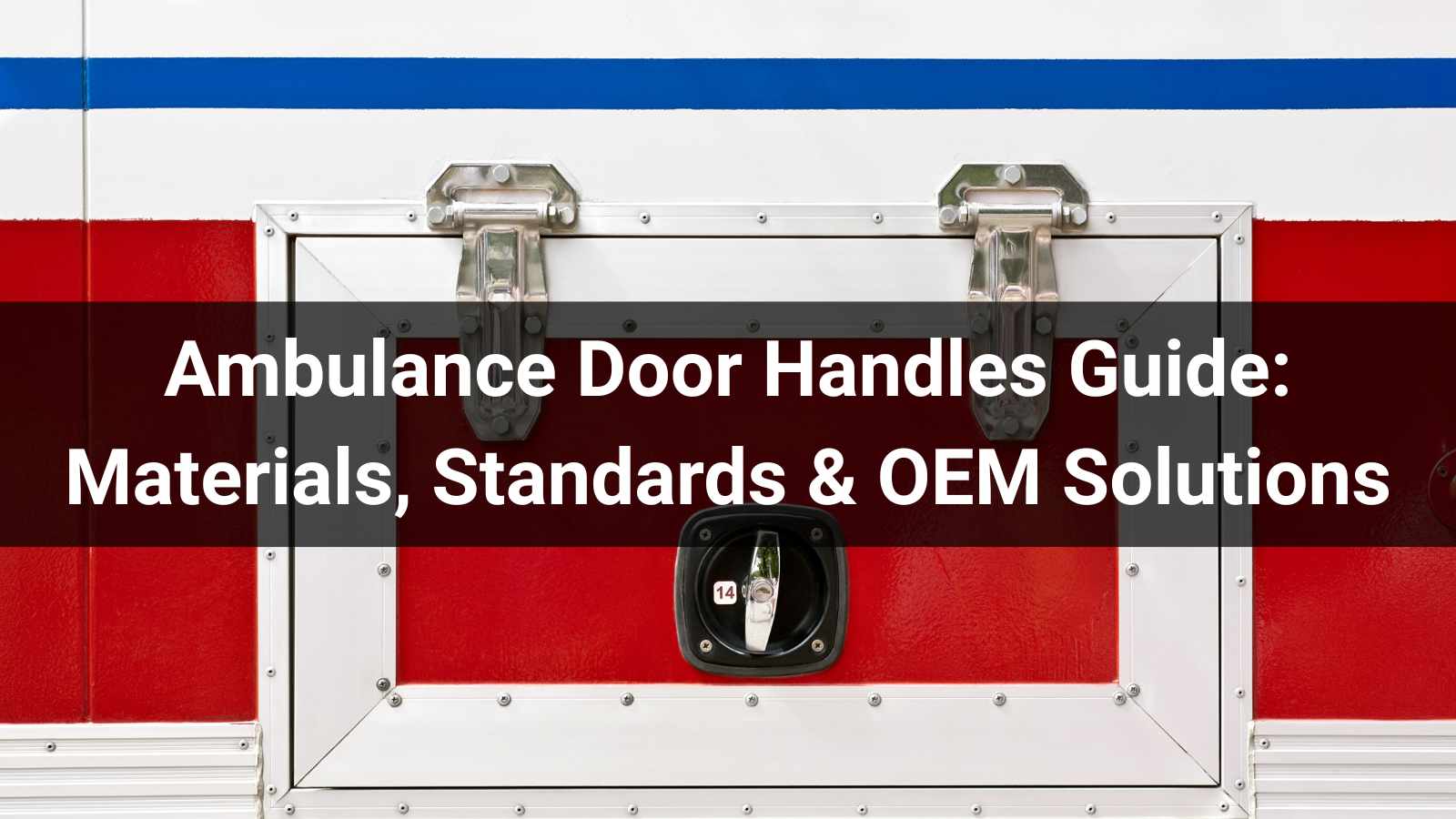 Sep 11, 2026Ambulance Door Handles Guide: Materials, Standards & OEM Solutions
 -
 Aug 15, 2026Truck Door Hinge: Complete Guide to Types, Materials, and Choosing the Right Supplier
 -
 Aug 12, 2026Ambulance Door Latch: Complete Guide to Emergency Vehicle Door Locking Systems
 -
 Aug 03, 2026Heavy Duty Truck Hinges: The Complete Guide to Materials, Types, and OEM Selection


Set A Consultation Today
Name can't be empty
Email error!
Send Your Message
*We respect your confidentiality and all
information are protected.

